The Beginning: Wu
Mei
Wu Mei Pai was named after its founder, the Shaolin
Buddhist nun Wu Mei (Ng Mui in the Cantonese dialect). Wu Mei was one of the five Shaolin martial
arts heroes who survived the Manchu persecution in the 17th century.
The daughter of a general in the Imperial Army, she
was raised in the palace of the
Wu Mei created a new form of horse-step training
using logs driven into the ground in a huge matrix of patterns of five, the
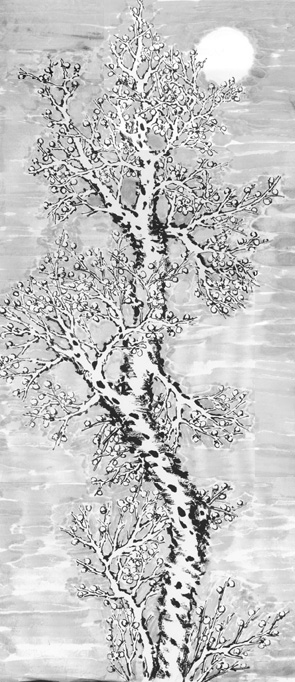
number of mystical order and power in Chinese thought. She called the five pattern “plum blossom
petals”,
Being a woman, Wu Mei could not match the external
strength of her male contemporaries with their greater muscle and bone
mass. Therefore she developed ways to
apply Chi Kung to fighting movements and innovated
many internal sources of strength and power.
Using multiple internal energy sources, Wu Mei enhanced internal power
so that she not only equaled but even exceeded the strength of many of the most
powerful martial arts masters. Her development
of an internal martial art paralleled the creation of Chen family Tai Chi
Chuan.
Wu Mei also developed unique fighting strategies:
the "form from no form", and the "strategy of no
strategy". Because she didn't train
in prearranged fight sequences, her actions were unpredictable. "Form from no form" would appear as
needed. With no strategy, her mind could
be clear and still as a lake, free to spontaneously respond to her opponents'
actions. Wu Mei believed in
instantaneous counters, so the Wu Mei method today contains no blocks, grabs,
or slaps, which would add an unnecessary step to the counter-attack.
In the mid-seventeenth century the Manchu invaded
Evening